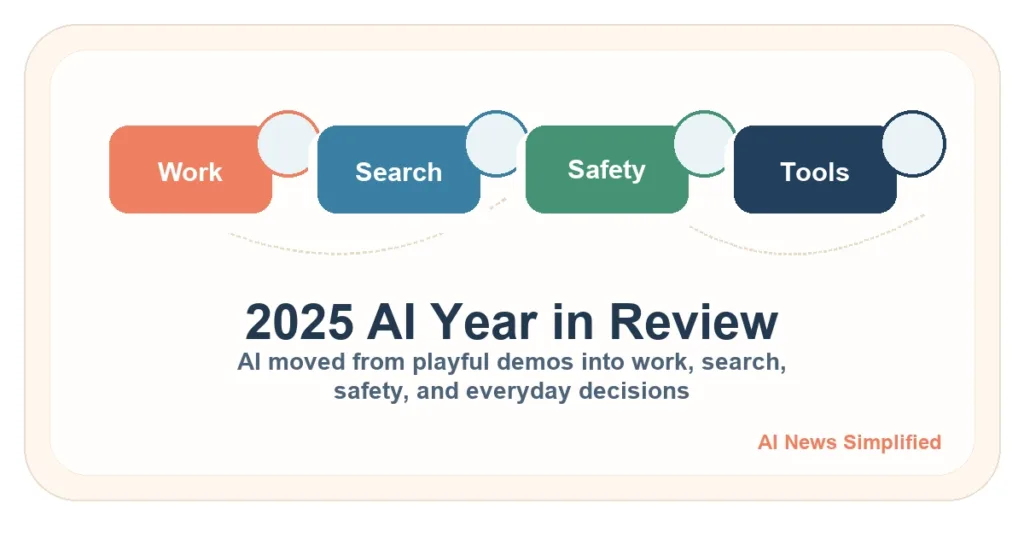
2025 was the year AI grew arms and legs. It was not only answering questions anymore. It was searching, clicking, researching, coding, and getting plugged into giant buildings full of computers. If 2024 was when AI moved onto your screen, 2025 was when it started asking for office space, power lines, and a job title.
The biggest stories
-
The building boom became impossible to miss. OpenAI announced the Stargate Project in January, with plans to invest $500 billion over four years in new U.S. AI infrastructure. Later in the year, Stargate kept growing with more sites and more capacity, while Anthropic announced its own $50 billion infrastructure push. The lesson was simple: AI does not run on magic dust. It runs on chips, electricity, land, cooling, and money the size of a small country’s budget.
-
AI started doing multi-step work, not just chatting. OpenAI launched Operator, then deep research, and later folded those ideas into ChatGPT agent. That meant AI could browse the web, gather sources, analyze files, and carry out longer tasks with less hand-holding. Instead of acting like a very fast answer machine, AI began acting more like a junior helper who could take a list and start working through it.
-
Search and everyday tools became much more AI-shaped. Google expanded AI Overviews and introduced AI Mode, then pushed AI Overviews to more than 200 countries and territories in over 40 languages. Meta launched a standalone Meta AI app built with Llama 4 to make AI feel more personal and voice-first. By the end of 2025, AI was not a side button anymore. It was becoming part of search, apps, browsing, and daily routines.
-
The top models got stronger and more useful for real work. OpenAI introduced GPT-5 as a major work-focused model, aiming at writing, coding, analysis, and complex business tasks. Across the industry, the best systems were getting better at following directions, using tools, and staying useful over longer jobs. The mood changed from “Look what this can say” to “Look what this can help finish.”
-
Safety got more serious because the stakes got higher. Anthropic activated AI Safety Level 3 protections alongside Claude Opus 4, which is a stricter internal safety mode for more powerful systems. That was one of the clearest public signs that frontier labs believed stronger systems needed stronger brakes. In plain English: the cars were getting faster, so the guardrails had to get stronger too.
What changed after that
Early 2026 already looks like the next chapter of the same story. The tools from 2025 are being pushed deeper into schools, hospitals, software, and governments. The argument is no longer about whether AI matters. It is about who can build it, who can afford it, and how safely it can be used.
Why this year mattered
2025 was the year AI stopped feeling like a toy for asking clever questions and started feeling like infrastructure and labor. It became part coworker, part utility bill, and part policy headache. That may not sound romantic, but it is how big technologies grow up.
What this means for me?
The 2025 story affects normal people because AI became more like a coworker than a novelty. That can help with writing, research, and planning, but it also changes what skills employers, schools, and customers may expect.
Official sources:
Announcing The Stargate Project
Introducing deep research
Introducing Operator
Introducing GPT-5
Expanding AI Overviews and introducing AI Mode
AI Overviews expand to over 200 countries and territories, more than 40 languages
Introducing the Meta AI App: A New Way to Access Your AI Assistant
Activating AI Safety Level 3 protections
Anthropic invests $50 billion in American AI infrastructure