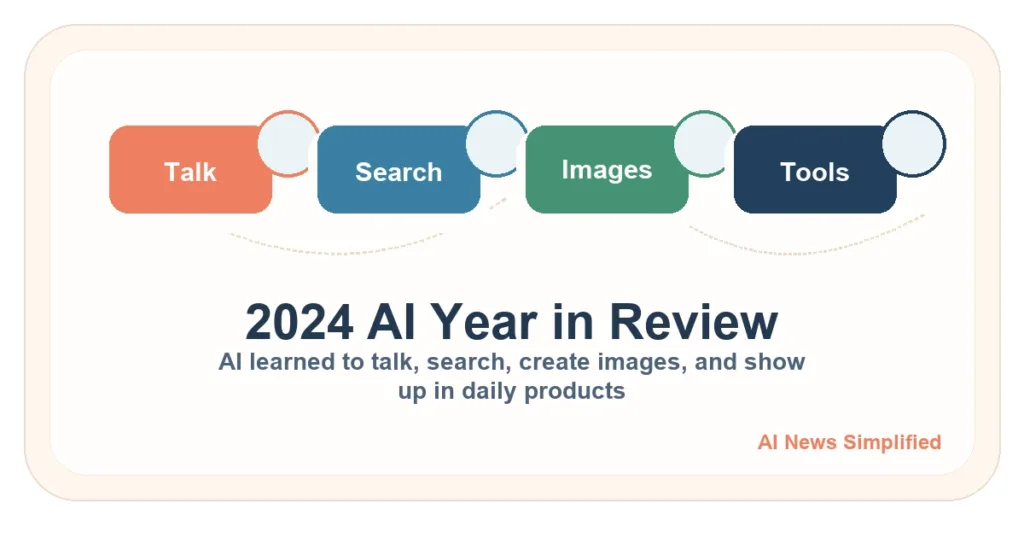
2024 was the year AI stopped feeling like a weird science fair trick and started showing up in places normal people actually use every day. It learned to listen better, search better, see better, and even follow more rules. If 2023 was the year people said, “Wait, what is this thing?”, 2024 was the year they said, “Oh, this is going to be everywhere.”
The biggest stories
-
OpenAI launched GPT-4o, and AI got much more natural. GPT-4o could work across text, images, and audio in real time. That meant talking to AI started to feel less like sending a letter and more like having a fast back-and-forth conversation. For regular people, this was a big deal. AI was getting less clunky and more human-sized.
-
Search changed in public. Google rolled out expanded AI Overviews in Search, while OpenAI started testing SearchGPT and later launched ChatGPT search. The simple shift was this: instead of hunting through ten blue links, more people started asking full questions in plain language. But 2024 also taught an important lesson. When AI gets facts wrong in public, people notice fast. Search became more useful, but trust became more important too.
-
AI got better at seeing, coding, and using tools. Anthropic launched Claude 3.5 Sonnet, then later added computer use. That gave AI stronger vision skills, better coding skills, and the ability to click, type, and move around software more like a person. It was like going from a smart student who answers questions to a helper who can actually touch the keyboard.
-
Open and social AI got stronger. Meta rolled out Meta AI built with Llama 3 across Facebook, Instagram, WhatsApp, Messenger, and the web. That mattered because AI was no longer trapped on one special website. It was moving into the apps people already used to chat with family, plan trips, and waste time in line at the grocery store.
-
The rulebook finally started to arrive. On August 1, 2024, the European Union’s AI Act entered into force. That did not solve every problem, but it showed governments were done treating AI as just a future issue. Real rules were starting to show up, and companies now had to think not only about what AI could do, but also what it should do.
What changed after that
2025 took the ideas from 2024 and made them bigger. Better voice and search turned into agents that could take actions. Better models turned into workplace tools. And the need for power, chips, and safety rules got much harder to ignore.
Why this year mattered
2024 was the year AI stopped being mainly a tech demo. It became a daily tool, a search feature, a creative helper, a coding assistant, and a political problem all at once. In other words, it stopped knocking on the door and came inside.
What this means for me?
The 2024 shift means AI became part of search, messaging, coding, and public rules. For normal people, that makes AI more convenient, but also makes digital literacy and fact-checking more important.
Official sources:
Hello GPT-4o
Generative AI in Search: Let Google do the searching for you
What happened with AI Overviews and next steps
Claude 3.5 Sonnet
Introducing computer use, a new Claude 3.5 Sonnet, and Claude 3.5 Haiku
Meet Your New Assistant: Meta AI, Built With Llama 3
AI Act enters into force