
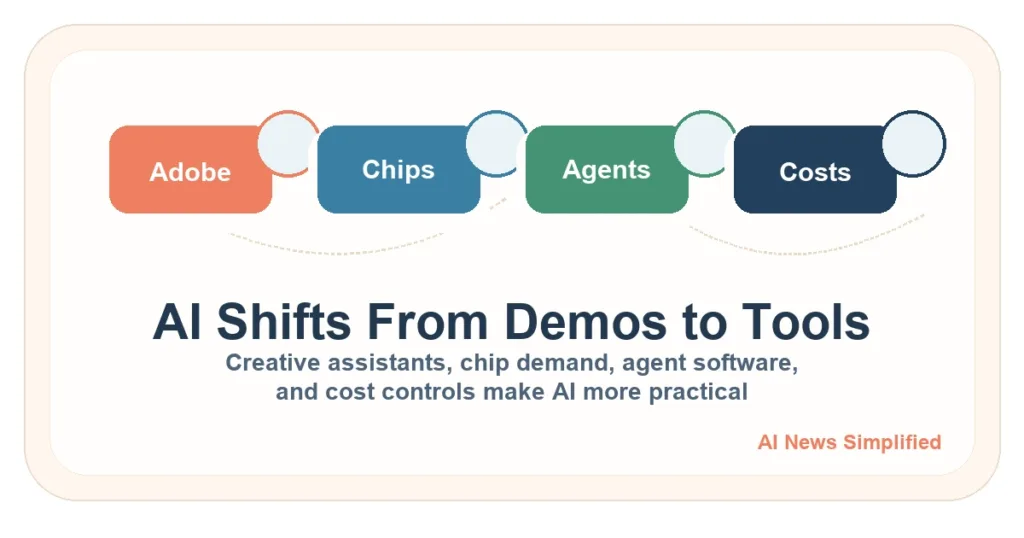
Today’s AI news had one clear theme: companies are trying to make AI feel less like a magic trick and more like a real tool. That means easier creative work, steadier costs, smarter software helpers, and a lot more demand for the chips that power it all.
- Adobe wants creative apps to feel more like a conversation. Adobe said Firefly AI Assistant is coming soon to Firefly. It lets you describe what you want in plain words, and the system handles a chain of steps across apps like Photoshop, Premiere, and Lightroom. Adobe also rolled out new video tools and a simpler Color Mode in Premiere beta. This matters because creative work often gets stuck in menus and tiny settings; Adobe is trying to turn that maze into a conversation.
- TSMC’s numbers say the AI chip rush is still very real. TSMC, the chip company that makes many of the world’s advanced AI chips, reported first-quarter revenue of $35.9 billion, up 40.6% from a year ago. It also forecast $39.0 billion to $40.2 billion for next quarter, which suggests demand is still climbing fast. This matters because every AI chatbot, image tool, and coding helper runs on huge piles of chips. When TSMC keeps growing like this, it is a sign the AI buildout is still in full swing.
- OpenAI gave AI helpers a safer place to work. OpenAI updated its Agents SDK. In simple terms, that is a tool kit that helps developers build AI helpers that can inspect files, run commands, and keep working through longer jobs. The big change is safer sandbox support, which means the AI works inside a locked play area instead of roaming freely on a computer. This matters because AI is slowly moving from answering questions to doing real tasks, and safety rails will matter more as that shift continues.
- Google is trying to make Gemini bills less scary. Google added prepay billing to the Gemini API. An API is a way one piece of software talks to another, and prepay means developers can load credits before they start instead of waiting for a surprise bill later. Google also says people can set auto-reload when credits run low. This matters because one of the fastest ways to kill interest in an AI tool is a confusing invoice.
Bottom line: AI companies are still racing to make their tools more useful, but today’s news also showed something more practical: people want software that saves time, stays predictable, and does not need a PhD to use. That may be less flashy than a robot demo, but it is probably what will matter most in daily life.
What this means for me?
For most people, this means AI tools may get easier to use and harder to avoid. Faster chips and better apps can make helpful features cheaper, but they also make it more important to understand what data you are sharing.
Sources: