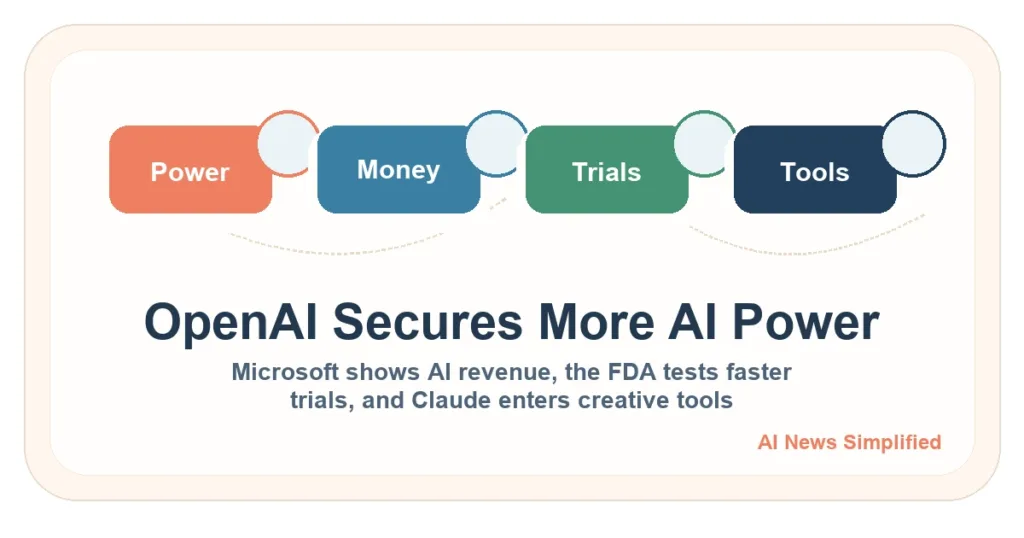
AI, short for artificial intelligence, is software that helps with thinking jobs like writing, sorting information, or spotting patterns. Today’s biggest AI news was not a flashy chatbot trick. It was about the heavy lifting behind AI: power, money, medicine, and tools people use to make things.
- OpenAI said it has already passed a big U.S. power goal for AI. On April 29, OpenAI said its Stargate project has already secured more than 10 gigawatts of AI infrastructure in the United States, even though that goal was originally set for 2029. A gigawatt is a very large unit of electricity. In simple terms, OpenAI is racing to build more digital factory space so future AI tools do not run out of room.
- Microsoft said AI is turning into a real business, not just an experiment. In its quarterly results on April 29, Microsoft said its AI business is now running at a $37 billion yearly pace, up 123% from a year ago, while Azure cloud revenue grew 40%. That matters because it shows companies are paying for AI at scale. When big customers keep buying, AI features are more likely to keep showing up inside the work software people already use.
- The FDA wants drug trials to move more like live traffic updates and less like mailed report cards. On April 28, the U.S. Food and Drug Administration said it started two proof-of-concept real-time clinical trials and opened the door to a wider pilot this summer. A clinical trial is a study that tests whether a treatment is safe and works. If the FDA can see safety signals right away, useful drugs could move faster and problems could be caught earlier.
- Anthropic pushed AI deeper into creative software. On April 28, Anthropic said Claude is getting new connectors for tools from Adobe, Autodesk, Blender, Ableton, SketchUp, and Splice. A connector is a bridge that lets one tool work with another. For artists, video editors, and designers, that could mean less time doing repetitive setup work and more time making the part people actually care about.
Bottom line: AI is starting to look less like a party trick and more like roads, hospitals, and office equipment. What this means for me? Better AI may soon feel more normal and more useful, but it will also depend on huge power builds, clearer safety checks, and tighter links to the tools people already know. For more plain-English updates, see our Latest News page and AI/LLM News hub.
Sources:
OpenAI: Building the compute infrastructure for the Intelligence Age
Microsoft: Q3 results
FDA: Real-time clinical trials announcement
Anthropic: Claude for Creative Work