
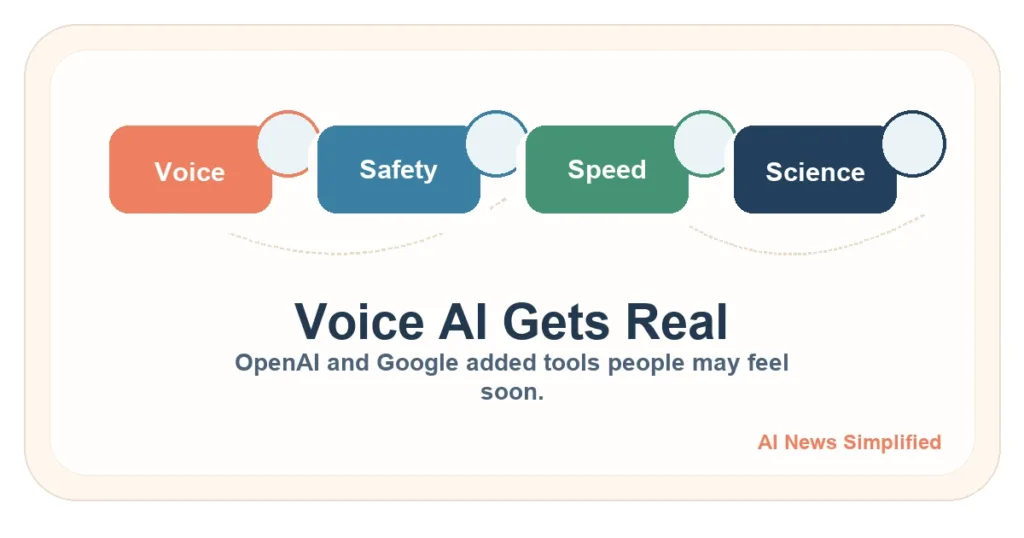
AI news moved fast on May 7 and May 8, 2026. The biggest theme was simple: AI companies are trying to make their tools more useful in real life, not just more impressive in a demo. Here are four updates that matter most if you use AI at work, at home, or just want to know where this is all heading.
-
OpenAI launched new voice tools for developers. OpenAI introduced three new audio models in its API, which is the system developers use to plug AI into apps. The headline feature is GPT-Realtime-2, a voice model that can listen, think, translate, and act during a live conversation. That matters because it could make phone help, travel tools, live translation, and voice assistants feel less like talking to a robot and more like talking to a capable helper.
-
ChatGPT added a new safety option called Trusted Contact. Adults can now choose one person they trust, like a family member or caregiver, who may be notified if ChatGPT detects a serious self-harm risk and trained reviewers agree there is real concern. OpenAI says the notice is brief and does not include chat transcripts. This matters because AI is becoming part of people’s private lives, so safety features need to connect users to real humans, not keep everything inside a chatbot.
-
Google made one of its cheaper Gemini models fully available. Google Cloud said Gemini 3.1 Flash-Lite is now generally available, meaning businesses can use it more widely in production. Google says the model is built for low latency, which means low delay, and lower cost on high-volume tasks like customer service, coding help, and fast data work. In plain English, this is the kind of update that can make AI features show up in more everyday products without making them too expensive to run.
-
Google DeepMind showed where AlphaEvolve is already helping. AlphaEvolve is a coding agent, which means software that can try ways to improve code and algorithms on its own. DeepMind says it helped cut DNA error detection problems, improved power-grid optimization, reduced storage waste inside Google systems, and sped up work in fields like logistics and drug research. This matters because the biggest AI gains may come quietly in the background, where better code can lower costs, save energy, and improve tools people use every day.
Bottom line: The AI race is not only about who has the flashiest model. It is also about who can make AI safer, faster, cheaper, and more useful in real-world products. For more plain-English coverage, visit our Latest AI News hub.
Sources:
OpenAI voice models
OpenAI Trusted Contact
Google Cloud on Gemini 3.1 Flash-Lite
Google DeepMind on AlphaEvolve