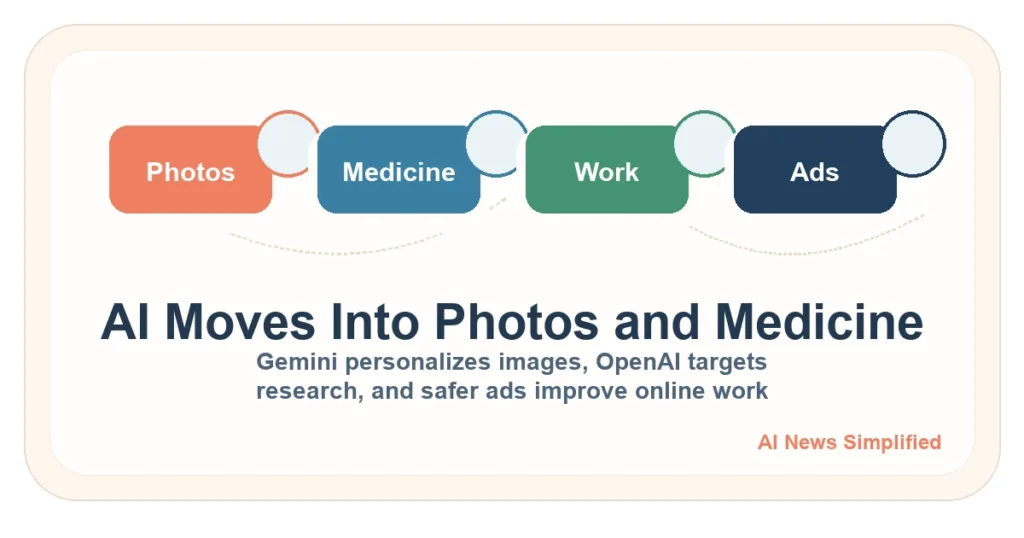
AI news felt more useful than flashy today. The big theme was simple: these tools are getting better at helping with real life, from family photos to drug research to office work and online safety.
-
Gemini can now use your Google Photos to make more personal images. Google said on April 16 that Gemini can use its image model, called Nano Banana, plus your Google Photos and preferences to make pictures that feel more like you. In plain English, that means less typing and fewer uploads when you want an image of yourself, your family, or your style. It matters because image tools are getting easier for regular people, not just prompt experts, though it is still smart to check your privacy settings before linking personal photos.
-
OpenAI launched GPT-Rosalind to help scientists work faster. OpenAI says this new model is built for biology, drug discovery, and medicine research. It is meant to help with hard jobs like reading papers, using science databases, and planning experiments. That matters because early drug research can take many years, and even small speed gains at the start can help real treatments reach patients sooner.
-
Anthropic says Claude Cowork is now ready for broader company use. In a webinar posted April 16, Anthropic said Claude Cowork is now generally available and added tools like role-based access, spending limits, and usage tracking. Those are manager tools that help a company decide who can use what and how much it can spend. This matters because AI helpers are moving from “interesting demo” to “tool your office may actually roll out.”
-
Google says Gemini is catching scam ads before people see them. In its 2025 Ads Safety Report, Google said Gemini-powered systems caught more than 99% of rule-breaking ads before they ran. Google also said it blocked or removed more than 8.3 billion ads and suspended 24.9 million accounts, including millions tied to scams. That matters in everyday terms because AI is not just making content now; it is also being used like a guard dog to spot trick ads faster.
Bottom line: Today’s AI news was less about robots taking over the world and more about useful steps that normal people can feel. Your photo app may get easier, scientists may get a faster helper, office workers may get a stronger digital assistant, and scam ads may have a harder time sneaking through.
What this means for me?
You may see AI in photo tools, health research, work apps, and ad systems. Some of that can be useful and convenient, but it also raises everyday questions about privacy, accuracy, and how much control people keep.
Sources:
Google: New ways to create personalized images in the Gemini app
OpenAI: Introducing GPT-Rosalind for life sciences research
Anthropic: Deploying Claude Cowork across the Enterprise
Google: 2025 Ads Safety Report