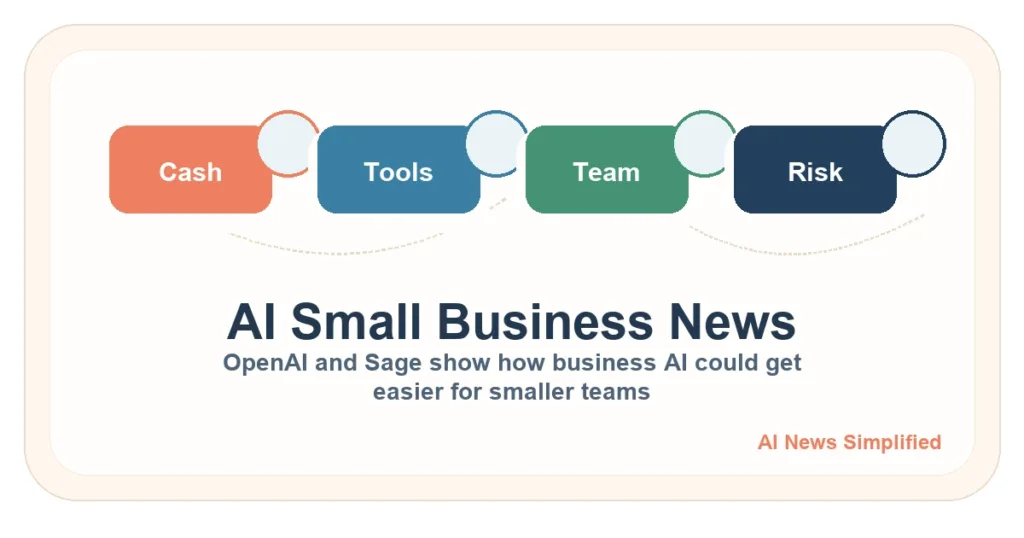
Two AI announcements this week point in the same direction: business AI is moving closer to the tools small companies already use.
AWS said OpenAI models, Codex, and OpenAI-powered managed agents are coming to Amazon Bedrock in limited preview. Sage also expanded its AWS partnership to bring more AI-powered finance tools and agent workflows to small and mid-sized businesses.
What changed
OpenAI is moving deeper into AWS. AWS says customers will be able to access OpenAI models through Amazon Bedrock, use Codex in AWS developer environments, and deploy managed agents powered by OpenAI. In plain English, this means companies that already use AWS may be able to buy and control OpenAI tools through systems they already know.
Sage is aiming AI at finance work for smaller companies. Sage and AWS said they are expanding their work together so small and mid-sized businesses can adopt cloud finance tools, use AI agents in financial workflows, and find Sage partner tools through AWS Marketplace.
Why it matters for small businesses now
Most small businesses do not have a full AI team. They need tools that show up inside accounting, payroll, customer service, email, websites, inventory, or office software. That is why this news matters: AI is becoming less of a separate experiment and more of a feature inside normal business systems.
For a small business, the near-term effect is not “replace everyone with agents.” It is more practical than that. The first useful wins are likely to be draft emails, summarize documents, check invoices, organize customer requests, create first drafts of marketing copy, and help staff find information faster.
What this means for me?
If you run a small business, this means AI tools may soon be easier to buy through vendors you already pay, especially if you use AWS-connected software or Sage products. That could reduce setup friction, but it does not remove the need for judgment.
The useful question is not “Should my business use AI?” The better question is: “Which boring task costs us time every week, and can an AI tool safely help with the first draft or first pass?”
How a small business could use this
- Finance: ask whether your accounting software can help flag unusual invoices, summarize cash flow, or prepare reports before a human reviews them.
- Customer service: test AI on draft replies for common questions, but keep a person in the approval loop.
- Marketing: use AI to create first drafts of product descriptions, local ads, email newsletters, and social posts, then rewrite them in your own voice.
- Operations: use AI to summarize policies, vendor emails, meeting notes, and long documents so staff can move faster.
- Software and websites: if you have a developer or agency, tools like Codex may help with small fixes, tests, documentation, and routine code tasks.
What to do before you try it
- Start with one workflow. Pick one repeated task, not your whole business.
- Protect customer data. Do not paste private customer, payroll, health, legal, or payment data into a tool unless your vendor agreement allows it.
- Keep human approval. AI can draft, sort, and summarize. People should still approve anything that affects money, customers, employees, or legal risk.
- Check the real cost. Watch monthly pricing, usage limits, add-ons, and whether the tool requires a more expensive plan.
- Measure the result. Track whether the tool saves time, reduces mistakes, or improves response speed. If it only adds another dashboard, stop using it.
Future impact
The future version of this is more connected. Instead of asking an AI chatbot a question, a business owner may approve an agent that checks invoices, prepares a cash-flow note, drafts customer emails, and updates a task list. That could help small teams do more with less admin time.
The risk is that small businesses may adopt automation faster than they build rules for it. The winners will not be the companies that turn on every AI feature. They will be the ones that choose a few useful workflows, protect sensitive data, and keep clear human review.
Bottom line
This AI small business news is not about a single magic tool. It is about AI becoming easier to reach through normal business platforms. For small businesses, the smart move is to test one practical task, measure the benefit, and avoid handing sensitive work to AI without a clear review process.
Sources
- AWS: Amazon Bedrock now offers OpenAI models, Codex, and Managed Agents in limited preview
- Amazon press center: Sage deepens AWS collaboration for small and mid-sized businesses
- OpenAI: Get access to OpenAI on AWS
Related plain-English guides
This news brief connects to a few broader AI topics:
- What is an AI agent?: Why agent tools can pursue goals through steps and still need human approval.
- ChatGPT vs Claude vs Gemini vs Copilot: How tool choice depends on workflow, ecosystem, and current provider details.
- AI privacy checklist for small businesses: What to check before using AI tools with customer or company data.
- AI for Small Business: Practical AI context for small teams.
- AI Tools: Plain-English AI tool coverage.
Reviewed July 6, 2026: This dated news brief was reviewed for links to newer plain-English AI guides. The original reporting and source context were not materially rewritten.
More plain-English guides for this topic
These newer evergreen guides explain terms and risks behind this older page:
- What is an LLM?: The model type behind many assistants and business AI tools.
- How to spot AI hype: Questions to ask before trusting broad AI product promises.
- AI scams to watch for: Risk checks for urgent messages, fake identities, and payment pressure.