AI news on May 7 was less about flashy chatbots and more about where AI gets used in the real world. The clearest theme was simple: labs want AI to do useful work inside big industries, but they also keep talking about safety tools and long-term oversight.
What happened
-
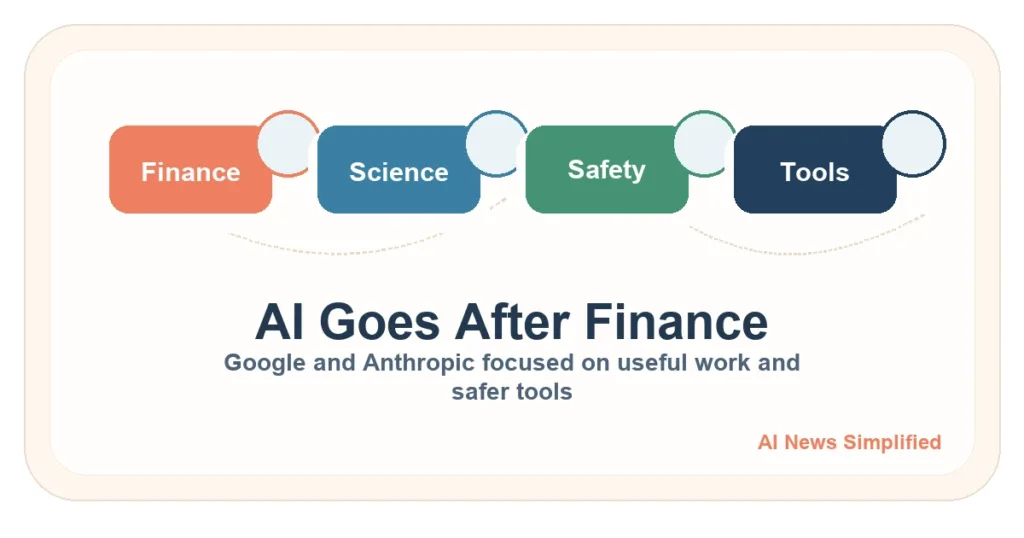
Anthropic pitched agents for financial services. Anthropic published a new push for finance agents, showing how Claude-based systems could help with research, workflows, and regulated business tasks. That matters because banks and money firms are slow to adopt risky tools, so when AI vendors target finance, they are aiming at one of the hardest and most valuable tests.
-
Google said AlphaEvolve kept paying off after its first year. Google published a one-year update on AlphaEvolve and said the system had continued to help with science and technology problems. This matters because the best sign that AI is useful is not a stage demo. It is when a company keeps using the system after the headlines fade.
-
Anthropic donated an open-source alignment tool. Anthropic said it was donating Petri, an open-source alignment tool built to help study and improve AI behavior. That matters because alignment means trying to make AI systems behave the way people intend, and shared tools can help more researchers check that work instead of taking a company’s word for it.
What this means for me?
- If you work in a heavily regulated field, watch finance rollouts closely because they often show what AI companies think is finally safe enough for serious business use.
- If an AI tool still looks useful a year later, that usually says more than launch-day hype.
- Safety tools are not exciting, but they matter because the people buying AI for real work will ask harder questions than consumers do.
Related reading: Latest AI News and AI/LLM News.
Bottom line: May 7 showed AI maturing in two directions at once: deeper business use and more effort to prove those systems can be trusted.