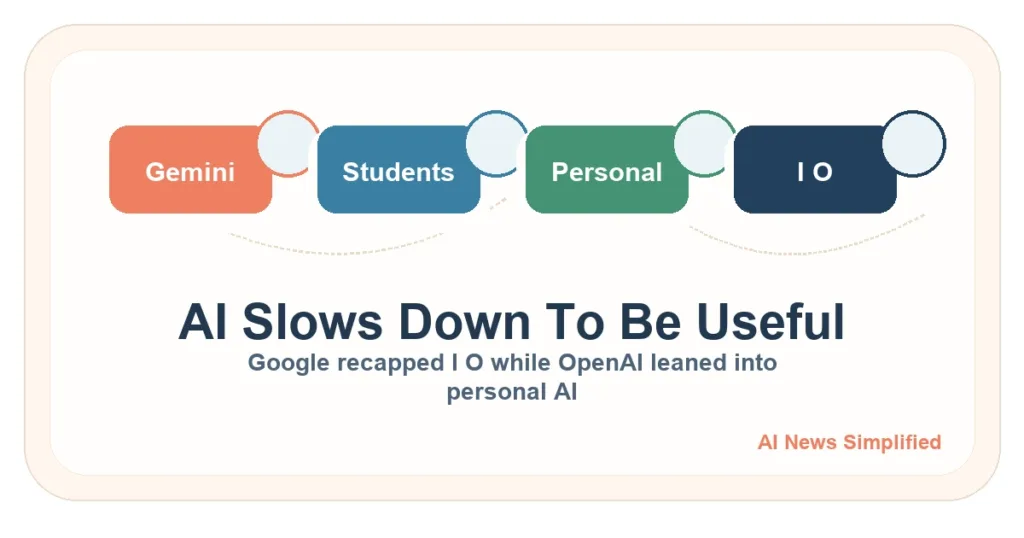
May 29 was not a giant launch day. It was a follow-through day. Google kept turning its I/O event into smaller, easier pieces, while OpenAI leaned into the idea that AI should feel more personal and tailored to the user.
What happened
-
Google released more videos on Gemini Omni and Gemini 3.5. Google published a set of short videos explaining Gemini Omni and Gemini 3.5 Flash. That matters because AI companies are learning that product launches are too dense for most people, so they need simpler follow-up content to make the tools usable.
-
Students at Waterloo used AI to prototype learning tools. Google highlighted student work at the University of Waterloo where teams used AI to prototype learning tools. This matters because some of the best clues about everyday AI use come from small practical projects, not billion-dollar launches.
-
OpenAI argued for more personalized AI. OpenAI published a case for personalized AI that adapts more closely to individual users and needs. That matters because AI becomes more helpful when it remembers context, but that same shift also raises harder privacy questions.
What this means for me?
- If AI feels hard to keep up with, expect more recap-style content built to slow the pace down.
- If students can build useful AI tools with lighter resources, smaller teams and nonprofits may be able to do the same.
- If personalized AI sounds helpful, it also means you should ask what the system remembers and for how long.
Related reading: Latest AI News and AI Tools And Work.
Bottom line: May 29 was about turning AI from a product event into a more personal, more understandable, and more usable experience.