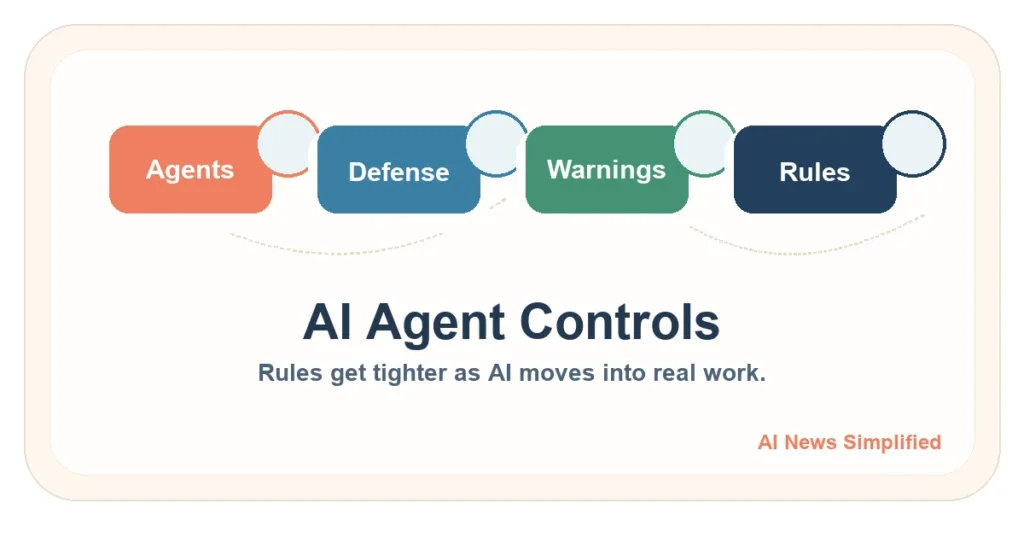
AI news felt less like a shiny toy day and more like a rulebook day. A big tech company started selling better controls for AI helpers, the Pentagon gave more AI firms access to classified work, and Italy pushed chatbot companies to be more honest about mistakes.
Microsoft started selling Agent 365. This new product is meant to help companies watch, secure, and manage AI agents, which are software helpers that can take actions instead of just answering questions. Microsoft says it costs $15 per user each month, or comes inside its new Microsoft 365 E7 package. That matters because businesses are moving from “let’s try AI” to “how do we keep this thing from wandering into the wrong file cabinet?”
The Pentagon opened more room for AI on classified networks. Reuters reported that the U.S. Defense Department reached agreements with seven AI companies, including OpenAI, Google, Microsoft, Amazon Web Services, NVIDIA, Reflection, and SpaceX, for use on high-security systems. Most people will never touch those systems, but the signal is clear: governments now see AI as core infrastructure, not a side experiment. That can speed up spending, testing, and pressure on companies to prove their tools are safe.
Italy pushed chatbot companies to add clearer warnings. Italy’s competition authority said DeepSeek, Mistral, and NOVA AI agreed to add stronger notices about “hallucinations,” which is the term for AI-made answers that sound confident but are wrong. The changes include permanent warnings in chat interfaces and clearer pre-signup information about limits and reliability. That matters in normal life because people use chatbots for homework, health questions, shopping, and work, and a confident wrong answer can be as useful as a broken map.
Bottom line: The big story today is not one flashy new model. It is that AI is being treated more like real-world infrastructure, with price tags, security controls, and clearer warning labels. In plain English: the tools are getting more serious, and so are the rules around them.
Sources:
Microsoft Agent 365
Microsoft on next-generation AI security
Reuters on Pentagon AI agreements
Italy competition authority on chatbot warning labels
Related plain-English guides
This news brief connects to a few broader AI topics:
- What is an AI agent?: The basics behind agent controls and approval steps.
- AI privacy checklist for small businesses: Data and access checks before teams use AI tools.
- ChatGPT vs Claude vs Gemini vs Copilot: A neutral assistant comparison for business workflows.
- AI Safety and Privacy: Safety, privacy, and policy context.
- AI Tools: Practical AI tool coverage.
Reviewed July 6, 2026: This dated news brief was reviewed for links to newer plain-English AI guides. The original reporting and source context were not materially rewritten.
More plain-English guides for this topic
These newer evergreen guides explain terms and risks behind this older page:
- How to spot AI hype: A checklist for reading claims about controls, agents, and governance.
- AI scams to watch for: Safety context for risky requests and impersonation attempts.
- What is an LLM?: Plain-English background for model-powered assistants.
Newer plain-English guides
These newer guides explain the agent-control and cybersecurity ideas behind this older news brief:
- Browser agent guardrails: Why controls matter when AI tools can take action.
- AI cybersecurity threats in plain English: How access, prompts, deployment, and monitoring can create risk.