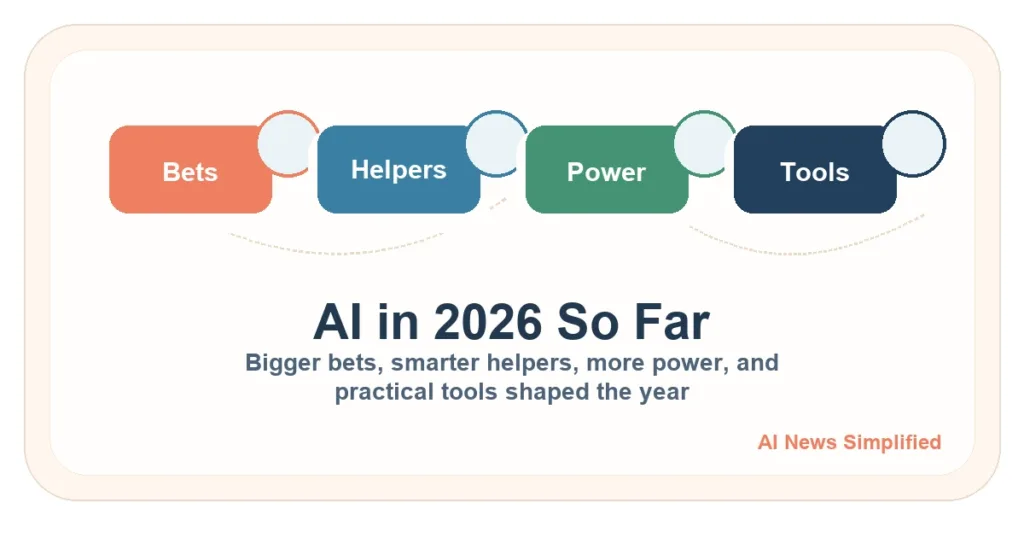
We are only partway through 2026, but AI has already had a very big year. The tools got stronger, the money got bigger, and the buildings behind the tools got much more important. If earlier years were about showing off, 2026 has been more about turning AI into something that can do real work at real scale.
The biggest AI stories so far in 2026
-
AI turned into a building-and-power race. OpenAI pushed hard on infrastructure with OpenAI for Healthcare in early January, a partnership with SB Energy tied to Stargate, a giant Amazon partnership in February, and a $122 billion funding round in March. Meta also announced new chip partnerships with Arm in March and Broadcom in April. In plain English, the AI race is no longer only about who has the smartest model. It is also about who has the power, chips, cooling, and giant rooms full of computers to run those models.
-
AI helpers started acting more like junior coworkers. OpenAI launched Frontier for big-company AI helpers and pushed GPT-5.4 as a model built for professional work, with stronger coding, tool use, and computer-use skills. Google spent March making Gemini more useful across Search, Maps, Docs, Sheets, Slides, and Drive. The pattern is easy to see: companies want AI that does steps, not just AI that writes paragraphs.
-
Healthcare and education moved closer to the front. OpenAI launched products aimed at hospitals and care systems. Google announced AI literacy training for 6 million U.S. educators. That matters because the most valuable AI stories are not always the flashiest ones. A tool that saves a doctor time or helps a teacher prepare a lesson can matter more than a clever demo that goes viral for one day.
-
Safety became a bigger public part of the story. Anthropic released Responsible Scaling Policy 3.0 in February, adding more public reporting and outside review. OpenAI launched Trusted Access for Cyber and then expanded it in April with GPT-5.4-Cyber for vetted defensive users. The simple point is this: the stronger these systems get, the more companies feel pressure to explain the rules, not just the features.
-
Search and everyday tools kept getting more personal. Google rolled out more Search Live, more Personal Intelligence, and tighter Gemini connections across products people already use. Adobe also introduced Firefly AI Assistant in April, aiming to let people describe a creative result and let the software handle more of the steps. AI is moving closer to the places where people already work, learn, and create instead of waiting for them to open a separate special app.
-
The year still feels young. One reason 2026 has felt so busy is that many of these announcements are foundations, not finish lines. Bigger data centers, new safety systems, more powerful models, and classroom or hospital rollouts all take time to prove themselves. The better way to read the year so far is this: the pieces are being locked into place.
What changed after the first wave
April made the pattern even clearer. OpenAI expanded trusted cyber access, Google pushed AI training for educators, Adobe moved toward a more agent-like creative assistant, and Meta doubled down on custom chips. That is a sign the year is shifting from giant platform news to practical rollout news.
Why 2026 matters so far
So far, 2026 looks like the year AI stopped asking to be taken seriously and started demanding a seat at the grown-up table. It is showing up in hospitals, classrooms, spreadsheets, search boxes, and data centers. That does not mean every promise will come true. But it does mean AI is becoming harder to ignore, and more important to explain clearly.
Bottom line: The biggest AI story of 2026 so far is not one single chatbot or one flashy demo. It is the shift from talking systems to working systems, backed by much larger bets on chips, power, safety, and real-world use.
What this means for me?
The big 2026 pattern is that AI is moving into normal systems like hospitals, schools, offices, and power grids. That means the effects may show up as changed forms, new work tools, different bills, or new rules rather than as one dramatic moment.
Official sources:
Introducing OpenAI for Healthcare
OpenAI and SoftBank Group partner with SB Energy
Introducing OpenAI Frontier
OpenAI and Amazon announce strategic partnership
Introducing GPT-5.4
OpenAI raises $122 billion to accelerate the next phase of AI
Introducing Trusted Access for Cyber
Trusted access for the next era of cyber defense
The latest AI news we announced in March 2026
Google launches AI literacy training for 6 million U.S. educators
Introducing Firefly AI Assistant
Meta partners with Arm to develop new class of data center silicon
Meta partners with Broadcom to co-develop custom AI silicon
Anthropic Responsible Scaling Policy 3.0