Quick answer: AI needs stronger human oversight when a mistake could affect money, accounts, rights, safety, employment, customers, confidential data, or an action that is hard to reverse. Low-consequence internal drafts may be spot-checked after validation. Consequential outputs should be reviewed every time, and consequential actions should require approval before they happen.
Checked July 17, 2026. This is an educational operating framework, not legal, employment, lending, medical, safety, or compliance advice.
Key takeaways
- Review checks an AI output. Approval authorizes an action.
- The highest-risk factor should set the oversight level; do not average away one severe risk.
- A human reviewer needs time, evidence, competence, and authority to reject or stop.
- Permissions and stop conditions matter as much as output accuracy when AI can act.
- The matrix should be revisited when the model, data, workflow, audience, or rules change.
The four-level approval matrix
| Level | Use it when | Plain example |
|---|---|---|
| Block | The use is prohibited, uses unapproved sensitive data, has no competent reviewer, or has no safe override/stop path. | Letting an unapproved public chatbot decide which employee should be fired. |
| Approve every action | AI can change money, accounts, permissions, legal commitments, employment, health/safety, rights, or an irreversible external state. | An agent prepares a refund, but a person confirms the amount and recipient before submission. |
| Review every output | The output is public, customer-facing, factual, policy-related, or consequential but still reversible before use. | AI drafts a customer policy explanation; a qualified person checks the source and wording before sending. |
| Spot-check | The workflow is validated, low-consequence, reversible, internal, and uses non-sensitive data, with periodic drift checks. | AI reformats internal meeting notes into a standard template. |
Rate the task before choosing a level
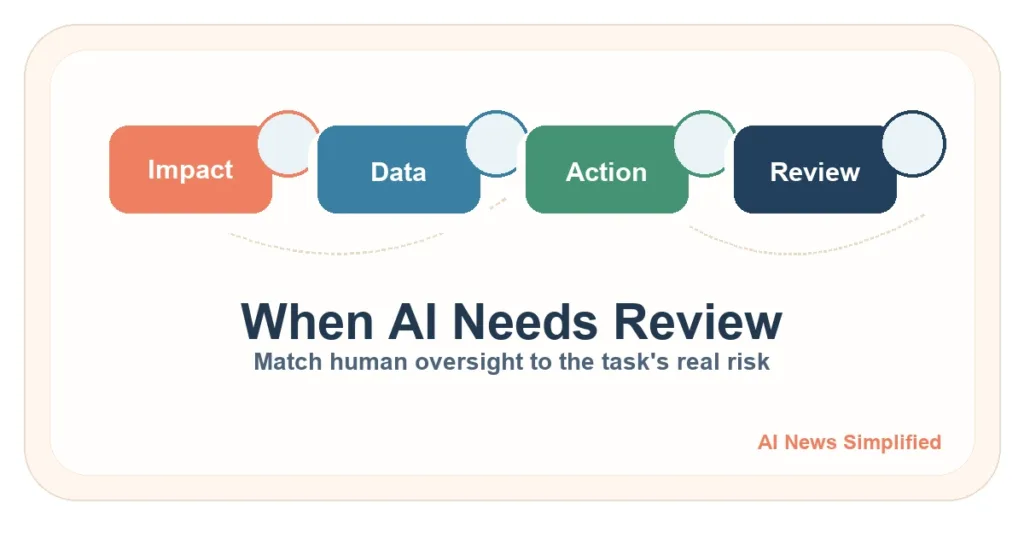
- Impact: What is the most serious plausible harm if the output or action is wrong?
- Reversibility: Can a mistake be undone fully and quickly?
- Audience: Is it an internal draft, a customer message, a public claim, or a decision about another person?
- Data: Does it use customer, employee, health, financial, legal, account, or confidential information?
- Autonomy: Does AI only suggest, or can it send, buy, delete, publish, approve, or change access?
- Obligations: Do contracts, policies, laws, professional duties, or sector rules require specific review?
Use the strongest applicable level. A reversible draft does not stay low-risk if it contains sensitive data. A highly accurate system still needs approval if it can make an irreversible payment.
What makes human review real?
- Named owner: one role is accountable for the review.
- Competence: the reviewer understands the task and common AI failure modes.
- Evidence: the reviewer can inspect the original source, not just the AI answer.
- Time: the workflow does not pressure people into rubber-stamping.
- Authority: the reviewer can reject, correct, escalate, or stop the system.
- Record: important approvals, exceptions, and failures are logged.
NIST’s AI Risk Management Framework emphasizes clear human/AI roles, documented oversight, risk tolerance, and controls matched to context. The words “human in the loop” do not satisfy those goals by themselves.
Examples that usually need approval every time
- Sending money, refunds, purchases, or financial instructions.
- Changing account access, permissions, passwords, or security controls.
- Signing or accepting legal commitments.
- Making employment, lending, insurance, housing, education, health, or safety decisions.
- Publishing a high-impact claim in the organization’s name.
- Sending sensitive data to another person, system, or provider.
A one-minute review worksheet
| Task | What exactly may AI produce or do? |
|---|---|
| Worst plausible harm | Who or what could be affected? |
| Evidence | What source will the reviewer check? |
| Reviewer | Who has the skill, time, and authority? |
| Stop condition | What error or uncertainty blocks the action? |
| Level | Block, approve every action, review every output, or spot-check? |
Regulated examples are not universal rules
The EU AI Act includes human-oversight requirements for high-risk systems, including understanding limits, watching for automation bias, overriding output, and stopping the system. U.S. agencies have also explained that complex AI does not erase existing duties in areas such as lending and employment. These examples show why context matters; they do not turn this general matrix into legal advice for every organization or location.
Limitations
No simple matrix can capture every sector, contract, law, vulnerable user, or unusual failure. A low-risk workflow can become higher-risk when connected to customer data or automated actions. Ask a qualified professional about regulated or high-impact uses.
Related guides
Apply the matrix with the AI Privacy Checklist, AI Customer Support Bots, Browser AI Agent Guardrails, AI for Small Business, and AI Safety and Privacy.