AI news felt less like a fireworks show and more like a building inspection this week. Governments, labs, and watchdogs all moved at once. The big theme is simple: people still want faster AI, but they also want clearer rules and better tests before trusting it with bigger jobs.
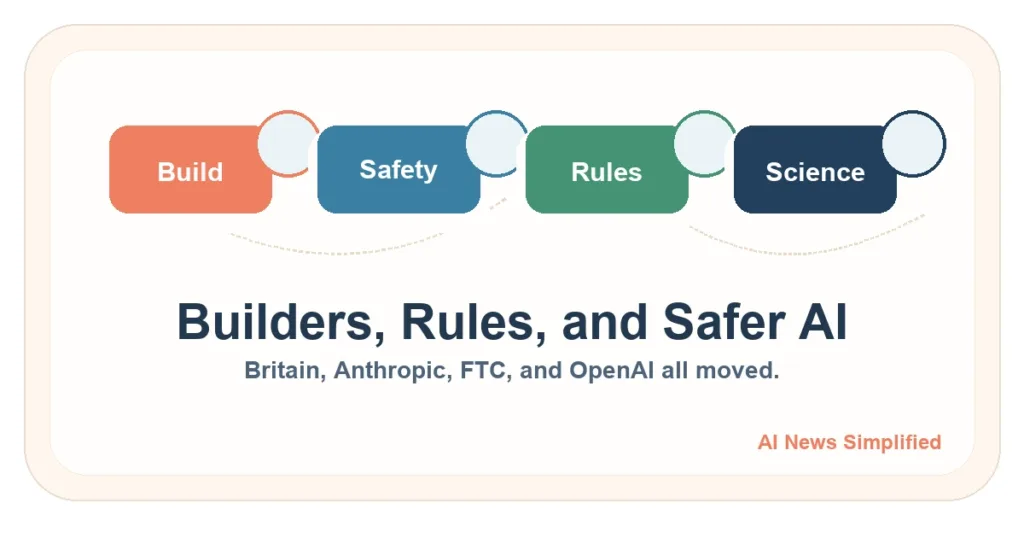
- Britain is giving open-source AI builders a push. The UK said it will give more than £500,000 worth of computing power to teams building public-service AI tools. Open-source means the code can be inspected and improved by many people, not locked in one company basement. That matters because cheaper, shared tools can help small groups build useful services instead of waiting for tech giants to do everything.
- Anthropic reopened Fable 5 and showed more of its safety plan. Anthropic said Fable 5 is back after a government pause, and it published a draft system for rating AI jailbreaks, which are tricks that try to make an AI ignore its safety rules. The company says it wants a clearer way to judge how dangerous a jailbreak really is. For everyday users, that means AI companies are under pressure to prove their tools are helpful without also handing out a lock-pick set.
- The FTC wants public comments on AI accuracy. The Federal Trade Commission, the U.S. consumer watchdog, opened a comment period on a proposed policy statement about whether AI companies mislead people when their systems are presented as objective or accurate. In plain terms, the agency is asking: if an AI sounds neutral, can companies quietly steer the answer anyway? That matters because people are starting to use AI for money, work, and life decisions, and a confident wrong answer can be more expensive than a broken toaster.
- OpenAI rolled out a harder science test for AI. OpenAI introduced GeneBench-Pro, a benchmark, which is a test, for checking how well AI handles messy biology research. The point is not just whether a model knows facts, but whether it can make careful judgment calls when the data are unclear. That matters because if AI is going to help with health and science, it needs more than a good memory; it needs the good sense to say, “this result is shaky.”
Bottom line: AI is still speeding up, but the real story right now is who gets to shape it, test it, and trust it. That may sound less flashy than a model launch, but it is the part that decides whether these tools become everyday helpers or everyday headaches.
Sources: