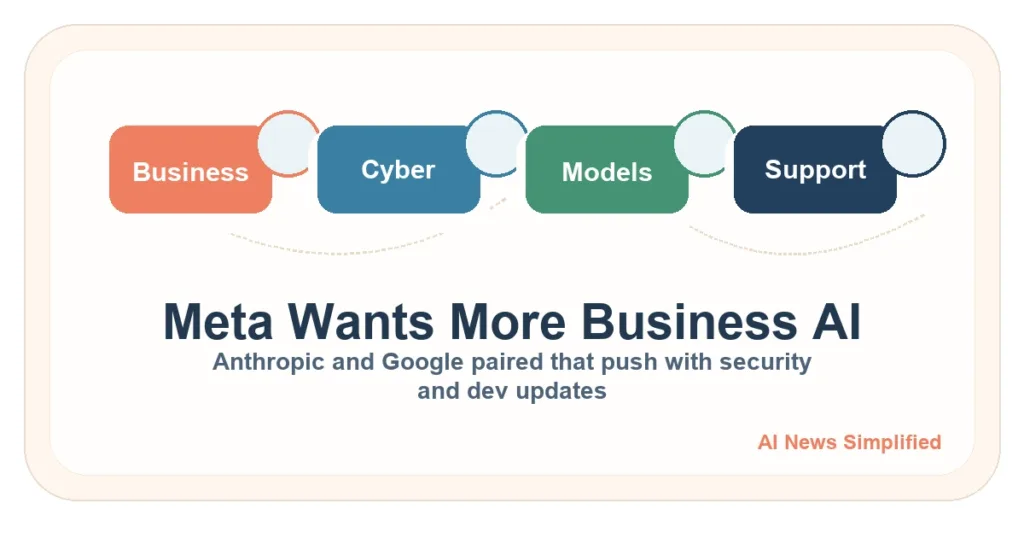
June 3 brought one of the clearest splits in AI news: one story was about AI helping businesses serve customers, and another was about what happens when bad actors use AI too. Both matter because the same tools can save time or create trouble depending on who is using them.
What happened
Meta introduced a business agent. Meta launched Meta Business Agent to help companies handle customer interactions and business tasks. That matters because the customer inbox is one of the first places where AI can save real labor for small and midsize teams.
Anthropic published a year of lessons from AI-enabled cyber threats. Anthropic shared a report on how AI had been used across cyber threat activity over the past year. This matters because better AI means both defenders and attackers get new tools, and regular users usually hear about the upside first and the risk later.
Google introduced Gemma 4 12B. Google announced a new Gemma 4 12B model for developers. That matters because smaller models can often be cheaper and easier to run, which makes them more realistic for startups, labs, and teams without giant budgets.
What this means for me?
- If you run a business, customer service remains one of the clearest places to test AI without rebuilding your whole company.
- If AI gets better at helpful work, it also gets better at misuse, which is why cyber reports deserve more attention than they usually get.
- If you build with AI, smaller models are often where practical adoption starts.
Related reading: Latest AI News and AI For Small Business.
Bottom line: June 3 showed the two-track future of AI: more everyday business help and more pressure to handle security risks at the same time.
Sources
- Be There for Every Customer With Meta Business Agent
- What we learned mapping a year’s worth of AI-enabled cyber threats
- Introducing Gemma 4 12B
Related plain-English guides
This news brief connects to a few broader AI topics:
- What is an AI agent?: Why agent tools can act across steps and need boundaries.
- AI privacy checklist for small businesses: A practical checklist for reducing AI data exposure.
- AI Safety and Privacy: Plain-English coverage of AI risk and policy.
- AI for Small Business: Practical context for small teams.
Reviewed July 6, 2026: This dated news brief was reviewed for links to newer plain-English AI guides. The original reporting and source context were not materially rewritten.
More plain-English guides for this topic
These newer evergreen guides explain terms and risks behind this older page:
- AI scams to watch for: A plain-English guide to AI-assisted fraud and verification steps.
- How to spot AI hype: Questions for evaluating AI safety and threat claims.
- What is an LLM?: Background on the language models behind many AI systems.
Newer plain-English guides
These newer guides expand on the business-agent and cyber-threat threads in this story:
- Customer support bot checks: What to check before AI answers customer questions.
- AI cybersecurity threats in plain English: How to group AI security risks without jargon.
- Browser agent guardrails: Why agents that act across websites need clear limits.