
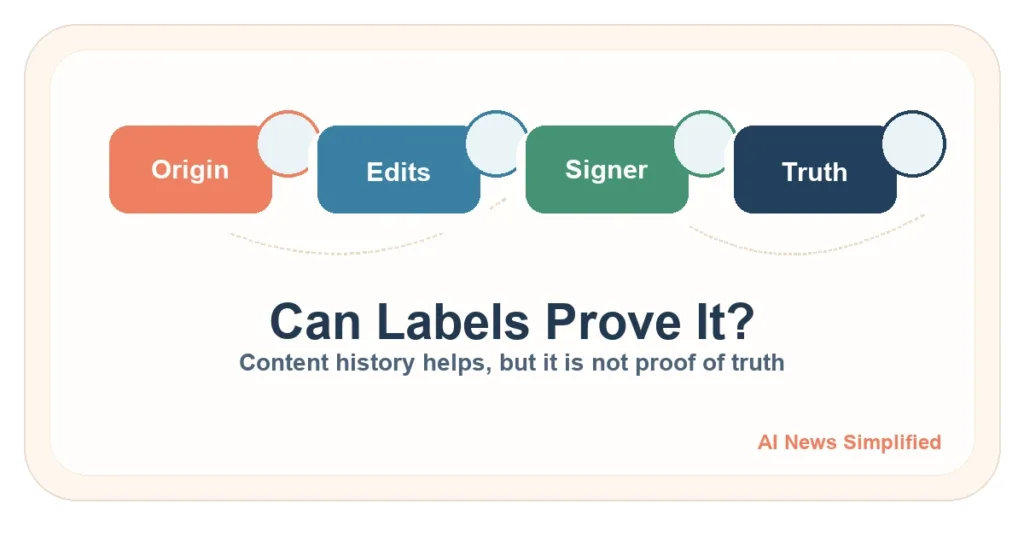
Quick answer: No—not by themselves. Content Credentials can provide signed, tamper-evident information about an image or video’s origin, tools, edits, ingredients, and AI involvement. That history can be useful evidence, but it does not prove that the scene, caption, identity, or real-world claim is true.
Checked July 17, 2026. This guide reflects C2PA specification 2.4 and current NIST guidance. The specification, verifier behavior, platform support, and adoption examples can change.
Key takeaways
- Content Credentials describe provenance: where media came from and what happened to it.
- Cryptographic signatures and hashes can make a record tamper-evident.
- Fingerprints or invisible watermarks may help reconnect credentials after normal transformations.
- Missing credentials do not prove that media is fake or AI-generated.
- A valid credential does not prove the depicted claim is true; check the signer, context, and claim separately.
What are Content Credentials?
Content Credentials are based on the Coalition for Content Provenance and Authenticity (C2PA) standard. A credential can attach signed assertions to media, such as the creating device or software, editing actions, ingredients, timestamps, and whether an AI tool was involved. The record is designed to be tamper-evident, so changes to the protected asset or manifest can be detected.
Think of it as a chain-of-custody record for a file, not a truth detector. A receipt can show where a package moved without proving that every statement printed inside the package is accurate.
Visible labels, hard bindings, and soft bindings
| Part | What it does | Main limitation |
|---|---|---|
| Visible label | Gives people a place to open provenance information | A label can be copied or imitated; inspect the actual credential |
| Hard binding | Uses cryptographic hashes to bind a manifest to the exact asset | Resizing, recompression, or screenshots can create a different file |
| Soft binding | Uses a fingerprint or invisible watermark to help identify a related rendition and recover provenance | Matching involves robustness and detection tradeoffs |
| Digital signature | Shows that the assertion was signed by a particular credential holder and has not been altered undetectably | You still need to decide whether the signer and assertion are trustworthy |
What a valid credential can help verify
- The signed provenance record has not been changed without detection.
- The signer associated with the credential.
- Recorded creation tools, edits, ingredients, and AI-use assertions.
- Whether the current asset still matches the protected binding.
- Whether a related rendition can be reconnected through a supported soft binding.
What it cannot prove
- That the scene happened as claimed.
- That a caption, date, location, or identity is correct.
- That the signer is honest or authoritative.
- That the media is free of misleading framing or omitted context.
- That the person who holds the file owns the copyright or has consent.
- That missing credentials mean the file is fake.
Why credentials may be missing
Credentials are optional and not every camera, editor, generator, platform, or messaging app supports or preserves them. A screenshot, export, social-media transformation, or format conversion may detach the manifest. Older genuine media may never have had credentials. A missing record is an unanswered provenance question, not a verdict.
A 60-second reader check
- Open the credential: use the platform’s supported interface or the official Content Credentials verifier.
- Check validation: does the asset and manifest validate, or is there an error or missing record?
- Check the signer: who signed it, and do you recognize or trust that source?
- Check creation and edits: what tools, ingredients, and transformations are actually recorded?
- Check completeness: are there gaps, detached steps, or claims that the credential does not cover?
- Fact-check separately: verify the depicted event, caption, date, location, and identity with reliable sources.
Four examples
- Camera photo: a credential may show capture and edits. It cannot prove the caption explains the scene correctly.
- Edited photo: the record may disclose cropping or color adjustments. It may not tell you whether the edit changes the story’s meaning.
- AI-generated image: a tool may assert AI generation. A credential can preserve that assertion, but adoption is not universal.
- Screenshot or repost: credentials may be stripped or detached. A soft binding may help recovery, but absence is not proof of deception.
Limitations
Provenance systems depend on adoption, signer trust, credential handling, and reader access. Watermarks and fingerprints face tradeoffs involving compression, cropping, distortion, false matches, missed matches, removal, and adversarial tampering. Treat provenance as one layer of evidence alongside source verification, context, and fact-checking.
Related guides
For the underlying media types, read Multimodal AI Explained. For deception and claim checks, use AI Scams to Watch For, How to Spot AI Hype, and AI Safety and Privacy.