For small businesses, startups, and independent development teams, building software with artificial intelligence relies heavily on a stable set of tools. When tech giants buy up the infrastructure or change their software platforms, small teams must act quickly to adapt. Two major shifts in the developer ecosystem this week highlight this dynamic: Anthropic’s acquisition of the startup Stainless, and Google’s consolidation of coding tools under the new “Antigravity” brand. Understanding these shifts is key for any team utilizing AI for small business workflows and following the latest AI news.
What changed
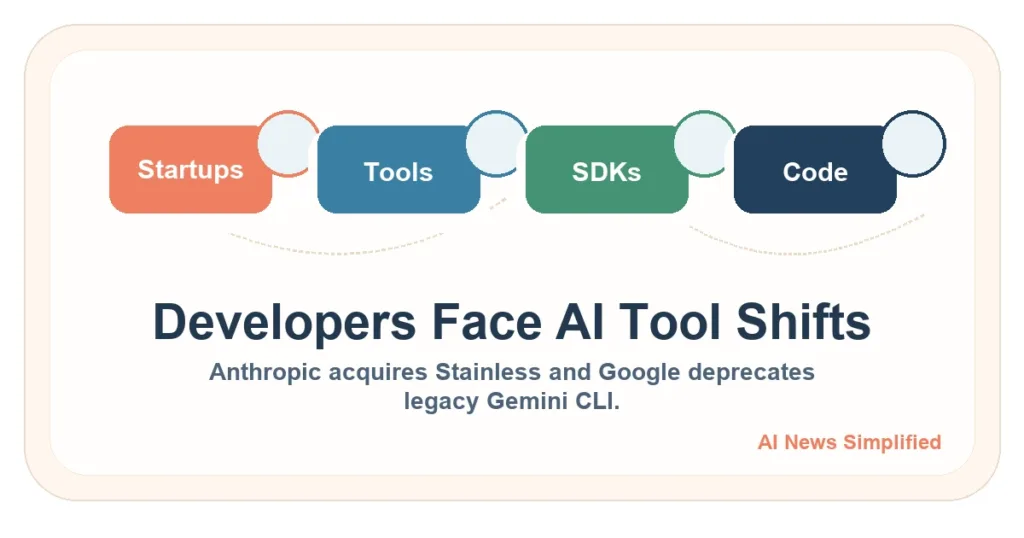
First, Anthropic announced it has acquired Stainless, a developer tools startup that specializes in generating Software Development Kits (SDKs) and Model Context Protocol (MCP) servers. SDKs are the software packages that developers use to connect their code to an AI model’s API, and MCP is an open standard that helps AI agents connect to database tools. Following the acquisition, Stainless is winding down its hosted generation platform as its team joins Anthropic. This means that while existing generated SDKs will keep working, small businesses that used Stainless as a third-party service to automate their API SDKs must now find other ways to build and update them.
Second, Google has unveiled “Antigravity,” a unified platform for AI-powered coding agents, replacing older developer tools. As a result, Google announced that it will deprecate its legacy Gemini CLI (command-line interface) and several Gemini Code Assist IDE extensions on June 18, 2026. Free and Pro/Ultra subscribers must migrate to the new Go-based Antigravity CLI and agent platform to continue receiving coding help, while enterprise licensees have a longer runway but are encouraged to transition.
What this means for small businesses now
If your business builds software and has been using Stainless to automatically generate and maintain API packages for your customers or internal services, you will need to prepare for its hosted service to go offline. Your current SDKs are safe to use and modify, but you will need to transition your developer pipelines to self-hosted generator tools or alternative platforms. If you or your software builders rely on the Gemini CLI or extensions in your coding editors for quick coding help or script testing, your team needs to plan for the June 18 migration. Ignoring this deadline will cause your CLI commands to stop responding, disrupting daily coding tasks.
What it could mean later
In the long run, Anthropic taking Stainless in-house shows a clear focus on the “integration layer”—making sure Claude can seamlessly and securely connect to external databases, tools, and custom software. This could result in much more robust, native AI tools for small business agent setups down the road. For Google, the shift to the Go-based Antigravity platform signals that developer tools are moving toward background, multi-agent execution rather than simple code completion. While this means more powerful automation later, it also means small teams will have to adapt to more complex agent structures rather than simple chat interfaces.
How a small business could use this
To keep your workflows running smoothly, small teams should take the following steps:
- Audit your development dependencies: Speak with your engineering or developer team to confirm whether any customer-facing SDKs are built using Stainless’s hosted generators. If they are, begin exploring open-source SDK generation engines (like OpenAPI Generator) to bring the process in-house.
- Schedule the Google migration: Block out time for your developers to install the new Antigravity CLI and review Google’s official migration guides before the June 18 cutoff. This ensures no interruption in your AI-assisted programming.
- Explore Model Context Protocol (MCP): Since Anthropic is prioritizing MCP for Claude, look at how this open standard can help your business safely connect AI models to your local files or internal tools.
What to watch before spending money
Before buying new API management platforms or upgrading to Google’s Enterprise license just to delay the Gemini CLI migration, assess your team’s actual needs. The new Antigravity CLI is free for individual and Pro/Ultra tier users and offers faster, async processing. Small teams should test the new tool first rather than rushing to pay for enterprise licenses prematurely. Additionally, when searching for Stainless alternatives, look for open-source options that you can run locally, which protects you from being locked into another proprietary service that might be acquired by a tech giant in the future.
Sources
- Anthropic acquires Stainless: Anthropic Blog / TechRepublic
- Google Antigravity CLI and Gemini CLI deprecation: InfoWorld / Google Blog
Related plain-English guides
This news brief connects to a few broader AI topics:
- What is an AI agent?: Why tool access and approval matter for agent-style systems.
- ChatGPT vs Claude vs Gemini vs Copilot: A neutral comparison for choosing AI assistants.
- AI privacy checklist for small businesses: Data-handling basics before adding AI to workflows.
- AI for Small Business: Small-business AI explainers and news.
- AI Tools: Tool-focused AI coverage.
Reviewed July 6, 2026: This dated news brief was reviewed for links to newer plain-English AI guides. The original reporting and source context were not materially rewritten.
More plain-English guides for this topic
These newer evergreen guides explain terms and risks behind this older page:
- What is an LLM?: The model concept behind many coding assistants and AI tool updates.
- Multimodal AI explained: Why tool claims may involve text, code, images, audio, or documents.
- How to spot AI hype: Questions to ask before relying on tool-launch promises.