The Small-Business AI Brief
Week of Jul 20–Jul 26, 2026 · News cutoff Jul 26, 2026, 5:00 pm Pacific
Intro
AI companies have spent years telling owners that the technology can save time. OpenAI's July 21 announcement was an admission that access is not the same as adoption.
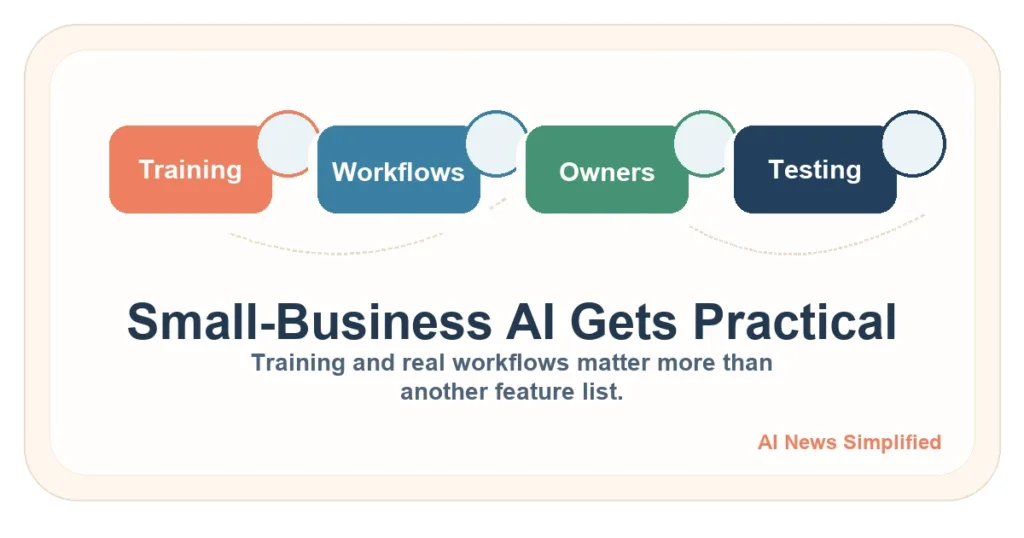
The company launched a ChatGPT program specifically for small businesses. It combines hands-on virtual training, in-person AI academies, new guides, curated partners and skills, and ways for owners to give feedback through Q&As, local events and surveys.
That direction matters more than another list of features. A small business rarely needs “more AI.” It needs help finding one recurring job that is worth improving, safe to test and easy for a person to review.
What changed
OpenAI said its virtual sessions would demonstrate small-business uses across areas such as accounting, marketing and ecommerce. The company also announced local academies, self-guided resources and partner workflows involving tools commonly used by smaller teams.
The announcement tied the program to ChatGPT Work, the multi-step agent OpenAI introduced earlier in July. It also invited owners to tell product and go-to-market teams what works, what is missing and what they need next.
OpenAI included results from earlier company-run AI Jams. Those figures are vendor-reported and are not independent proof that a new participant will save the same amount of time. The more useful test is whether one workflow improves inside an owner's own business.
What still needs proof
- Whether the training helps owners choose a high-value workflow instead of a flashy one.
- Whether partner offers remain useful after any promotion ends.
- Whether integrations provide appropriately narrow data and action permissions.
- Whether a workflow keeps saving time after setup, correction and review are counted.
- Whether owner feedback produces product changes rather than only marketing material.
Why it matters to a small business
Most small firms do not have an AI lead, automation engineer or governance committee. The owner, office manager or one curious employee becomes all three.
Practical instruction can shorten the path from “we should try AI” to a controlled experiment. It can also prevent a common mistake: buying several tools before anyone has named the business problem.
The feedback element is especially important. Owners see edge cases that a product team may not: seasonal demand, handwritten records, one shared inbox, unusual approval chains and work that depends on trust built over years. A useful program should listen before prescribing.
How this fits the historical sequence
Retrospective interpretation in the July 19 issue: vendors would invest in small-business onboarding, training and ready-made workflows because easier AI workspaces would not solve implementation by themselves.
What happened this week: OpenAI announced a program that combines those exact elements—training, academies, guides, partners and owner feedback.
Retrospective interpretation, written August 6: as small businesses connect AI to customer-facing and operational work, visible disclosure and simple governance will move from a future concern to a current operating requirement.
Our take on what comes next
Opinion: The next valuable layer in small-business AI will be human guidance that is independent of a single vendor.
Vendor training can teach a product. An owner still needs someone to ask whether the workflow is worth doing, whether the data belongs there and whether another tool—or no AI at all—would be simpler. That is an opening for a trusted, plain-English workflow clinic rather than a commission-driven tool recommendation.
Your move this week
Turn training into a measured pilot:
- Write the business priority for the next 30–90 days.
- Name one recurring point of friction that blocks it.
- Map how that work happens now, including every human decision.
- Compare possible AI uses on business value and delivery readiness.
- Select one high-value task that can be tested without disrupting customers.
- Record the baseline and success criteria before opening the tool.
- Review the result and decide: adopt, refine, expand, pause or stop.
Do not let a webinar's demo become permission to connect every app.
Evergreen cheat sheet: First Workflow Finder
Score ideas with questions, not hype:
- Priority: Does this support something the business actually needs now?
- Friction: Is the problem recurring and meaningful?
- Value: Could improvement affect time, quality, cost, revenue or customer experience?
- Readiness: Are approved inputs and a clear desired output available?
- Review: Can a knowledgeable person check the result?
- Reversibility: Can the test stop without harming a customer or core process?
- Decision: What will you do if it works, partly works or fails?
Retrospective context
| Field | Entry |
|---|---|
| Hypothesis reconstructed August 6 | AI use in customer-facing and operational work will make disclosure and governance a current small-business task. |
| Assessment basis | Written after the compared events; retrospective context |
| Comparison window from issue cutoff | 14 days, through August 9, 2026 |
| Evidence for comparison | A binding transparency milestone or official guidance that affects professional AI providers or deployers. |
August 6 retrospective context — later evidence, not part of the July 26 news report
Historical outcome: Article 50 transparency obligations under the EU AI Act began applying on August 2. The later milestone is covered in Issue 5 and documented by the European Commission's official guidance.
Free Small Business AI Workflow Clinic
OpenAI is asking owners what works and what is missing. We want to listen at the workflow level. Bring one recurring task to a free 30-minute conversation. We will help map a small, reversible test and email the one-page plan afterward. No charge and no sales pitch.
Request a free AI Workflow Clinic. Use the booking email to deliver the requested plan; ask separately and optionally about the weekly brief.
Framing correction — September 4, 2026: This historical issue was written on August 6. Earlier wording presented its retrospective comparisons as predictions made before the events. The labels now distinguish later analysis from advance forecasts; the coverage dates and reported source events are unchanged.
Sources checked
Email updates
Join the Weekly Brief waitlist
Leave your email to join the waitlist. Automated weekly email delivery is not active yet.
Joining the waitlist is separate from requesting a consultation. You can ask us to remove your email at any time.