The Small-Business AI Brief
Week of Aug 3–Aug 9, 2026 · News cutoff Aug 6, 2026, 5:00 pm Pacific
Intro
A little over two weeks ago, OpenAI announced that it would give small-business owners practical training. On August 6, that promise became a hands-on session about turning ChatGPT Work into everyday workflows.
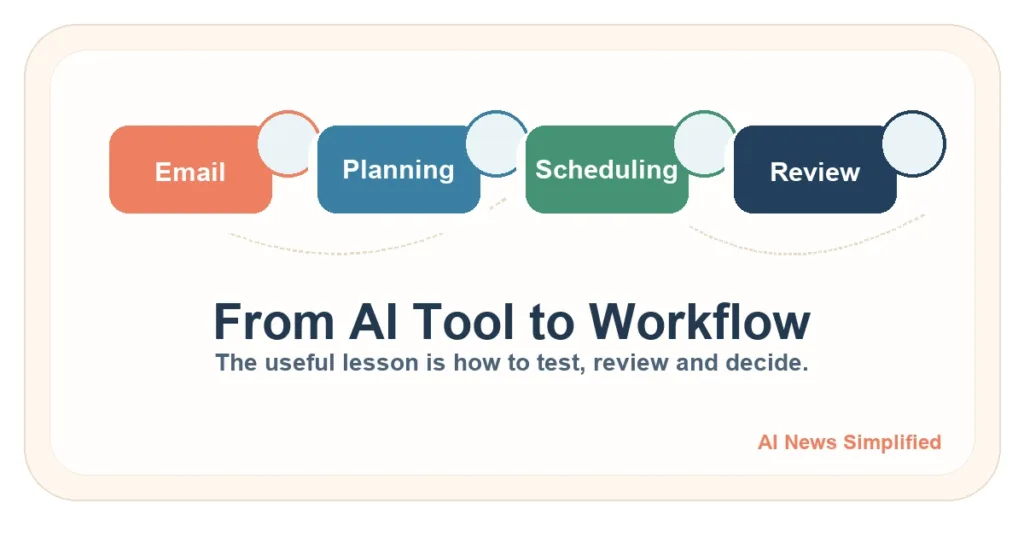
The official on-demand recording covers plugin setup, email management, draft automation, scheduling, capacity planning, scenario analysis and team Sites. That is a more useful signal than another sweeping promise that AI will transform business.
The lesson is not that every owner should automate email tomorrow. It is that AI becomes valuable when it has a bounded job, the right context, a visible result and a person who decides what happens next.
What changed
OpenAI's small-business page scheduled “How Small Businesses Can Put ChatGPT Work Into Practice” for August 6 at 9:30 a.m. Pacific. The session is now available on demand.
The chapter list shows a progression from setup to actual operating scenarios: connecting a plugin, managing email, preparing drafts, configuring scheduled work, planning capacity, comparing scenarios and creating a team Site.
This is the implementation phase of the program OpenAI announced on July 21. The product is still vendor-specific, but the underlying questions are universal: Which task matters? Which information is approved? What must a human check? How will the owner know whether the test worked?
What still needs proof
- Whether a demonstrated workflow fits the way a particular business actually works.
- Whether the plugin permissions are appropriate for live company data and actions.
- Whether scheduled tasks remain accurate when inputs change or an exception appears.
- Whether capacity or scenario analysis uses complete, current information.
- Whether time saved exceeds setup, monitoring and correction time.
Why it matters to a small business
Owners often get stuck between two bad choices: experimenting casually with sensitive work or postponing AI until they can afford a large project. A small, reversible workflow test offers a third path.
Email and planning are good teaching examples because the output is visible. An owner can compare a draft with the original information, count corrections and decide whether it deserves to be reused. That is very different from allowing an agent to send, buy or change records without a checkpoint.
The growing value is not just in the tool. It is in the person who can translate a messy business process into a safe test and explain the result without jargon.
Context from the historical issues
The July 19, July 26, and August 2 issues were all written on August 6. Their comparisons provide historical context; they are not a record of predictions published before the events.
Retrospective interpretation in the July 19 issue: easier AI workspaces would lead vendors to add small-business onboarding and workflow help.
What happened on July 21: OpenAI announced the program.
Retrospective interpretation in the July 26 issue: implementation support would become more important than a feature list.
What happened this week: the August 6 session walked owners through actual workflow categories, including email, scheduled work and planning.
Retrospective interpretation in the August 2 issue: owner education would need to combine workflow design with data limits, review and control.
What happened this week: the practical workflow half arrived. The available chapter summary is not enough to claim that every relevant disclosure and governance question was covered, so the evidence supports only the workflow part of that interpretation.
Our take on what comes next
Opinion: The most valuable small-business AI service will not be “we know the newest model.” It will be “we can help you improve one real job without losing control of it.”
Each weekly issue can end with one small action, one reusable cheat sheet and an invitation to talk to a human. The clinic offers practical help with a workflow. Reporting and prediction assessments use public evidence; private clinic or participant information is not an editorial source.
Your move this week
Run a seven-day, review-only workflow sprint:
- Day 1 — Choose: Name one business priority and one recurring friction point.
- Day 2 — Map: Write the trigger, inputs, steps, decisions and output used today.
- Day 3 — Bound: Choose five to ten representative examples; remove unnecessary identifying information.
- Day 4 — Test: Ask the AI to prepare one reviewable result. Do not authorize an external action.
- Day 5 — Review: Record errors, missing context, reviewer corrections and time spent.
- Day 6 — Compare: Check the result against the original baseline and success criteria.
- Day 7 — Decide: Adopt, refine, expand one small step, pause or stop.
A successful first test is evidence to repeat carefully—not permission to automate the department.
Evergreen cheat sheet: The 7-Day AI Workflow Sprint
Your one-page test card should contain:
- Baseline: What happens now, including time and common errors.
- Question: What should this test help the owner learn?
- Inputs: The minimum approved context and examples.
- Boundary: Actions, data and tools that remain off-limits.
- Reviewer: The person responsible for checking the result.
- Success: The observable standard the output must meet.
- Decision: Adopt, refine, expand, pause or stop.
Prediction tracker
| Field | Entry |
|---|---|
| Prediction recorded | Small businesses will value guided workflow diagnosis and measurement more than generic model news. |
| Status at issue cutoff | Unmeasured editorial opinion; no supporting result recorded here |
| Time horizon | 90 days, through November 4, 2026 |
| Proof signal | Publicly available research or documented surveys comparing small-business demand for workflow selection and measurement with demand for model news. Assess only published methods and results; private clinic or participant inputs are excluded. |
This prediction was published on August 6 and remains an unmeasured opinion here. Any assessment within the stated time horizon must use publicly available evidence.
Free Small Business AI Workflow Clinic
Bring one repetitive task, not a technology shopping list. In a free 30-minute call, we will ask what matters, map how the task works now and identify one safe test. Afterward, we will email a one-page workflow card you can use whether or not you choose ChatGPT.
Request a free AI Workflow Clinic.
Your consultation email is used to arrange the clinic and send your workflow card. Email signup is a separate, optional choice on the request form.
Framing correction — September 4, 2026: The linked historical issues were written on August 6. Their comparisons are now labeled as retrospective context. The forward-looking workflow-diagnosis prediction in this issue remains an unmeasured opinion.
Sources checked
Email updates
Join the Weekly Brief waitlist
Leave your email to join the waitlist. Automated weekly email delivery is not active yet.
Joining the waitlist is separate from requesting a consultation. You can ask us to remove your email at any time.