The Small-Business AI Brief
Week of Jun 29–Jul 5, 2026 · News cutoff Jul 5, 2026, 5:00 pm Pacific
Intro
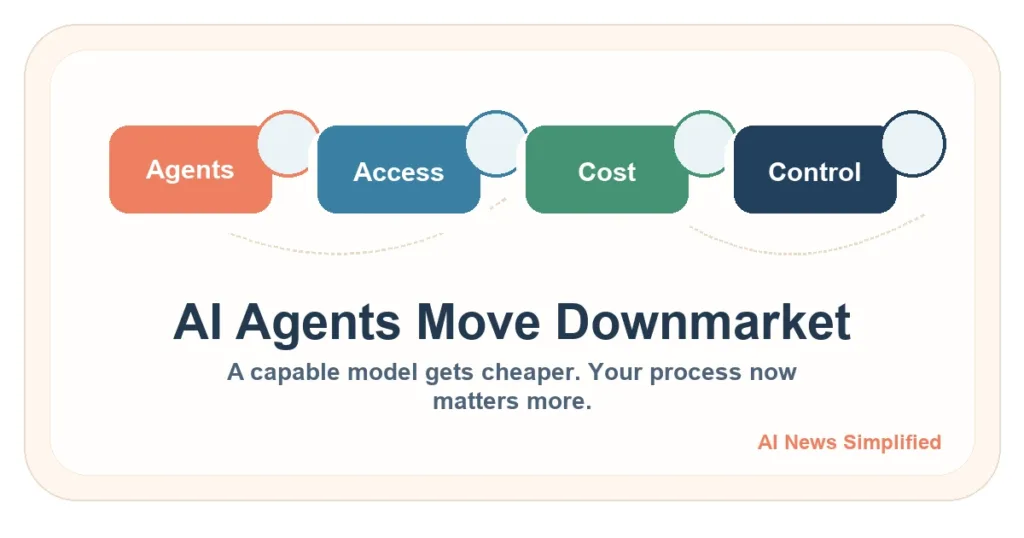
For a small business, the most important AI news this week was not a new benchmark trophy. It was that a model designed to plan, use tools and carry work through several steps moved into a less expensive, more widely available tier.
Anthropic released Claude Sonnet 5 on June 30. The company describes it as its most agentic Sonnet model yet: it can make a plan, use tools such as a browser or terminal, and continue working with less hand-holding than the previous Sonnet generation. Anthropic made it available across Claude plans and launched it through its developer platform as well.
That does not mean a small business should turn on every connection and walk away. It means the cost of trying a bounded AI worker is falling—and the quality of your instructions, permissions and review process is becoming the real differentiator.
What changed
Anthropic says Sonnet 5 narrows part of the gap between its mid-tier Sonnet line and more expensive Opus models, particularly for reasoning, tool use, coding and knowledge work. It also introduced temporary lower API pricing through August 31.
In plain English, the company is offering more follow-through in a model intended for everyday use. A task can include several steps instead of ending with a single answer.
Anthropic also published a system card and described pre-deployment safety testing. Those are useful disclosures, but the performance and safety comparisons are Anthropic's own evaluations. A benchmark result does not prove that the model will handle your customer emails, bookkeeping documents or operating procedures correctly.
What still needs proof
- Whether it performs consistently on a specific small-business workflow.
- Whether the time saved is greater than setup and review time.
- Whether its errors are easy for your team to spot.
- Whether the required plan, token use and connected tools fit your budget.
- Whether the workflow can stay within your privacy, contractual and professional obligations.
Why it matters to a small business
Larger companies can assign specialists to automation projects. A five-person firm usually cannot. A more capable model at a lower operating cost could let a small team test work that previously needed custom software or more expensive AI.
The best first use is not the most impressive one. It is a recurring task that is annoying, measurable and reversible. Think of preparing a weekly status brief from approved notes, comparing a set of supplier quotes, or organizing a draft follow-up list for a person to review.
The risk is treating capability as permission. A model that can use tools can make a mistake faster than a chatbot that only writes a draft. The owner still needs to decide what information it may see, which actions it may take and where it must stop.
How this fits the historical sequence
This is the first coverage window in the historical relaunch series. It was written on August 6, alongside the other historical issues.
Retrospective interpretation, written August 6: if capable agent-style models continue moving into lower-cost tiers, AI companies will package them into products that complete longer business jobs instead of only answering questions.
We are not calling that inevitable. We are recording it so we can check it later.
Our take on what comes next
Opinion: AI capability will become easier to buy. A small company's advantage will come from knowing its own work well enough to delegate one part safely.
The owner who can describe a good result, name the allowed inputs and spot a bad answer will get more value than the owner chasing every new model. Process knowledge—not prompt cleverness—will be the durable advantage.
Your move this week
Choose one task and make a tiny test card:
- Name the result you want in one sentence.
- List the minimum approved information the AI needs.
- List the tools it may use and the actions it may not take.
- Set a time or spending limit.
- Name the person who reviews the result.
- Define a stop rule, such as one missing source, one unexpected action or one customer-data concern.
- Test with sample or de-identified information before using live customer material.
Do not connect email, banking, payroll or a customer system merely to see what happens.
Evergreen cheat sheet: The Agent Permission Card
Use this before an AI touches a real workflow:
- Job: What single outcome is it responsible for?
- Inputs: What approved information may it use?
- Tools: What may it open or search?
- Actions: What may it draft, and what may it never send or change?
- Limit: When must it stop because of time, cost or uncertainty?
- Evidence: What sources, calculations or change log must it return?
- Reviewer: Who signs off before anything consequential happens?
Retrospective context
| Field | Entry |
|---|---|
| Hypothesis reconstructed August 6 | Lower-cost agent capability will be packaged into a product that completes longer business work. |
| Assessment basis | Written after the compared events; retrospective context |
| Comparison window from issue cutoff | 30 days, through August 4, 2026 |
| Evidence for comparison | An official product launch aimed at multi-step deliverables, connected work or scheduled execution—not just a model benchmark. |
August 6 retrospective context — later evidence, not part of the July 5 news report
Historical outcome: On July 9, OpenAI introduced ChatGPT Work as an agent for longer projects, connected apps and files, finished deliverables, and scheduled tasks. That later launch is covered in Issue 2 and documented in the official OpenAI release notes.
Free Small Business AI Workflow Clinic
Have a repetitive task but do not know whether it is a safe first AI test? Bring that one task to a free 30-minute clinic. We will map the inputs, limits, reviewer and success check, then email you a one-page test card. There is no charge and no tool sale.
Request a free AI Workflow Clinic. The booking form should collect the delivery email and offer a separate optional checkbox for the weekly brief.
Framing correction — September 4, 2026: This historical issue was written on August 6. Earlier wording presented its retrospective comparisons as predictions made before the events. The labels now distinguish later analysis from advance forecasts; the coverage dates and reported source events are unchanged.
Sources checked
Email updates
Join the Weekly Brief waitlist
Leave your email to join the waitlist. Automated weekly email delivery is not active yet.
Joining the waitlist is separate from requesting a consultation. You can ask us to remove your email at any time.