The Small-Business AI Brief
Week of Jul 6–Jul 12, 2026 · News cutoff Jul 12, 2026, 5:00 pm Pacific
Intro
The historical issue covering June 29–July 5 discusses cheaper agent-style AI. OpenAI moved toward products that finish a job on July 9 with ChatGPT Work. Both issues were written on August 6.
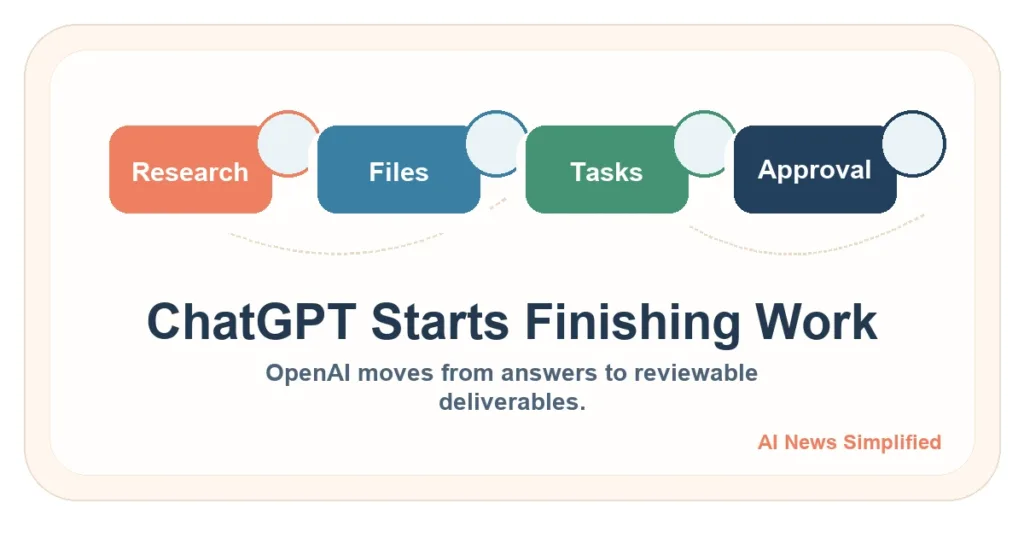
Work is meant for longer assignments. OpenAI says it can research and analyze information, work across connected apps and files, and produce finished documents, spreadsheets, presentations, reports and Sites. Owners can watch progress, answer questions, change direction and approve important actions.
That sounds like an extra pair of hands. It should be managed like one: give it a clear job, limited access and a person who remains responsible for the result.
What changed
OpenAI began rolling Work out on web and mobile to eligible paid plans, with staged availability by plan. The July 9 release also described Scheduled Tasks that can run once, repeat, trigger on a condition or monitor for changes.
OpenAI also replaced its App Directory with a Plugin Directory. Plugins can package skills, apps and templates around a workflow. Existing app connections were not supposed to change because of the directory migration.
The practical shift is from a conversation to a job with a deliverable. Instead of asking for ten isolated drafts, an owner can describe the outcome, provide approved context and review what the agent produces.
What still needs proof
- Work's reliability on your exact task and files.
- The amount of supervision it needs when information is missing or inconsistent.
- The actual usage cost for a long task.
- Whether a plugin's underlying app permissions are narrow enough for your business.
- Whether scheduled execution creates more value than review burden.
Why it matters to a small business
Small-business work rarely arrives as one perfect prompt. A customer request may require finding an earlier email, checking a policy, comparing dates, preparing a response and recording the next step. That is the kind of multi-step job agent products are trying to handle.
The opportunity is capacity. The danger is invisible action. If an agent can open files or use an app, the owner needs to know whether it can only read, can create a draft, or can actually change something outside ChatGPT.
Start where a mistake is cheap and visible. A reviewable weekly brief is a better first test than an automatically sent customer campaign.
How this fits the historical sequence
Retrospective interpretation in the July 5 issue: lower-cost agent capability would be packaged into products that complete longer business jobs.
What happened this week: OpenAI launched Work around multi-step projects, connected context, finished deliverables and scheduled execution.
That comparison describes product direction. It does not show that we forecast the launch before it happened or prove that the product will save time for every business.
Retrospective interpretation, written August 6: once agents can complete longer jobs, the next product race will center on persistent context—projects, instructions, files, history and access across devices.
Our take on what comes next
Opinion: The difference between a useful agent and a risky one will be the operating system around it: approved context, permissions, checkpoints and evidence.
AI companies will make delegation feel increasingly simple. Good management will remain stubbornly specific. An owner still needs to define what “done” means and what the AI must never do without asking.
Your move this week
Run a manual, review-only pilot:
- Pick a task that repeats at least weekly.
- Record today's baseline: time, handoffs, common errors and final reviewer.
- Provide five representative examples using approved or de-identified data.
- Ask Work for a draft or analysis, not an external action.
- Require it to list sources, assumptions, missing information and exceptions.
- Have the usual responsible person review the output.
- Decide whether to adopt, refine, pause or stop before considering a schedule.
If the first test is not useful, that is valuable evidence. Do not automate a weak process.
Evergreen cheat sheet: Chat, Work or Human?
- Use Chat for a quick question, brainstorm, explanation or lightweight draft.
- Use Work for a bounded multi-step job with approved context and a reviewable deliverable.
- Use Scheduled Work only after the manual version is reliable and every external action has an approval rule.
- Keep it human when the task involves legal judgment, financial commitment, employee decisions, sensitive customer situations or facts the reviewer cannot verify.
Retrospective context
| Field | Entry |
|---|---|
| Hypothesis reconstructed August 6 | Agent products will compete on persistent business context and continuity, not only model intelligence. |
| Assessment basis | Written after the compared events; retrospective context |
| Comparison window from issue cutoff | 14 days, through July 26, 2026 |
| Evidence for comparison | Official additions that make projects, instructions, files or Work history easier to find, reuse or continue. |
August 6 retrospective context — later evidence, not part of the July 12 news report
Historical outcome: OpenAI added broader search on July 14, longer custom instructions on July 15, and desktop Projects plus cross-device Work continuity on July 16. Those later changes are covered in Issue 3 and documented in the official OpenAI release notes.
Free Small Business AI Workflow Clinic
Bring one job you are considering for ChatGPT Work. In a free 30-minute clinic, we will help separate the steps an AI may prepare from the decisions a person must own. You will receive the one-page test plan by email.
Request a free AI Workflow Clinic. The email-newsletter checkbox should be optional and separate from the booking request.
Framing correction — September 4, 2026: This historical issue was written on August 6. Earlier wording presented its retrospective comparisons as predictions made before the events. The labels now distinguish later analysis from advance forecasts; the coverage dates and reported source events are unchanged.
Sources checked
Email updates
Join the Weekly Brief waitlist
Leave your email to join the waitlist. Automated weekly email delivery is not active yet.
Joining the waitlist is separate from requesting a consultation. You can ask us to remove your email at any time.